
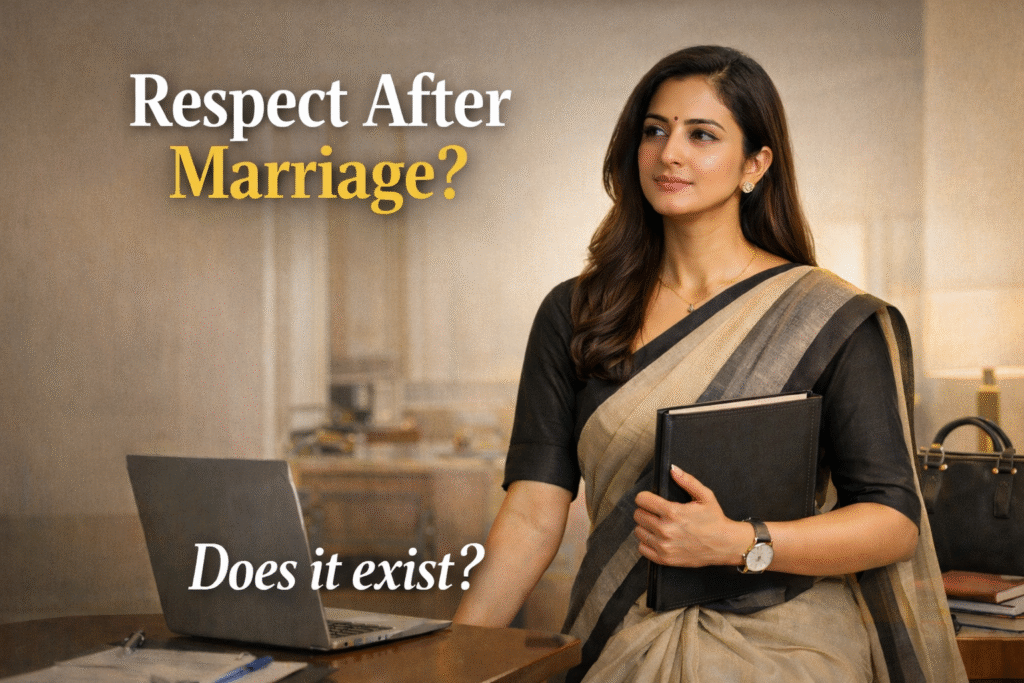
Women empowerment after marriage looks powerful on stages and social media.
But inside many homes, it quietly disappears.
Even today, respect after marriage remains a big challenge for many women — especially educated and working women.
A Simple Story: Meera
Meera is an educated woman.
She holds a good position at work and earns well.
She contributes equally to household expenses and manages family responsibilities with care.
At home, she handles work, family, and relationships together.
She respects elders, supports relatives, and maintains balance.
But during family gatherings, something changes.
Her husband often teases her in front of relatives — casually, jokingly, publicly.
He makes jokes about her nature, her thinking, and sometimes her work.
He laughs and says it is just fun.
Others smile.
But Meera feels uncomfortable.
She does not reply back.
She stays quiet to avoid conflict.
But inside, she feels hurt.
Have you ever felt this silence too?
She wonders why her achievements matter outside,
but inside the family, her dignity is not protected.
Meera is not weak.
She is responsible, capable, and independent.
She only wants respect after marriage, not praise.
This is not just Meera’s story.
This is the reality of many women.
This post shares some hard but real truths about women empowerment after marriage in Indian society.
1. Education Does Not Guarantee Respect at Home
Many women are highly educated, intelligent, and capable.
Yet after marriage, their reality looks like this:
- Their opinions are ignored
- Their intelligence is questioned
- Their growth is not taken seriously
Women empowerment after marriage looks impressive outside, but inside the home, respect is often missing.
2. Empowered Women Are Often Misunderstood
When a woman is:
- Confident
- Goal-oriented
- Independent in thinking
She is often labelled as:
- Difficult
- Over-smart
- Diplomatic
Instead of appreciation, her strength becomes a problem.
3. Working Women Are Accepted, But Not Valued
In middle-class families, both spouses working is now a necessity.
There are:
- EMIs to pay
- Credit card bills
- School fees
- Daily expenses
So working women in Indian society are accepted.
But the expectation is unfair:
- Earn money
- Manage the home
- Stay quiet
- Do not expect equal respect
This is not empowerment.
This is pressure.
4. “Ghar Ki Murgi Dal Barabar” Still Exists
No matter how successful a woman becomes outside, inside the home she is often taken for granted.
Her efforts are seen as normal.
Her struggles are ignored.
This mindset kills respect after marriage slowly and silently.
5. Empowerment Is Seen as Ego
When women speak up for:
- Self-respect
- Fair treatment
- Equality
It is often called ego or arrogance.
But asking for dignity is not ego.
It is a basic human need.
6. Emotional Support Is Missing
Women empowerment after marriage is not only about money or jobs.
It also needs:
- Emotional safety
- Kind words
- Trust
- Respect
Without these, even a strong woman starts doubting herself.
7. Society Needs a Mindset Change
This is not about blaming all men.
This is about changing a mindset where:
- Men dominate
- Women adjust
- Silence is expected
True women empowerment after marriage will exist only when respect after marriage becomes normal, not optional.
What Should Be Done to Change This Reality
Real change needs a strong mindset shift. Women should not lose dignity after marriage. Respect after marriage must be equal, whether a woman earns or not. Household and work responsibilities should be shared fairly. Men and women should be treated as partners, not competitors. Equality does not weaken families — it makes them stronger. True progress begins when respect, trust, and support become part of daily life.
A Collective Message to Society, Women, Families and Workplaces
- Create equal space and opportunities for both boys and girls from childhood.
- Teach respect, empathy, and equality, not dominance or control.
- Accept equality inside homes, not only in public or professional spaces.
- Share responsibilities fairly at home and at work, without gender bias.
- Recognize that education, voice, and dreams matter equally for women and men.
- Encourage growth and ambition for both partners after marriage.
- Treat men and women as equal individuals and partners, not roles.
- Make respect unconditional, not dependent on income, gender, or power.
Final Thought
Women are not asking for power over men.
They are asking for equality, dignity, and shared responsibility.
When homes change, society changes.
If you want a personal 1:1 session to gain clarity and emotional strength, you can book a session here → Book a Life Coaching Session.
Subscribe to my YouTube channel for videos on Women Empowerment, life experiences and workplace motivation: Suno Zindagi: Life Unmuted
Connect with me on LinkedIn: Suno Zindagi: Life Unmuted